

Lithium: Shri Sanjay Kumar Verma Highlights Material Sovereignty Strategy for India at CSIR-IMMT
By Tapaswini Sahoo
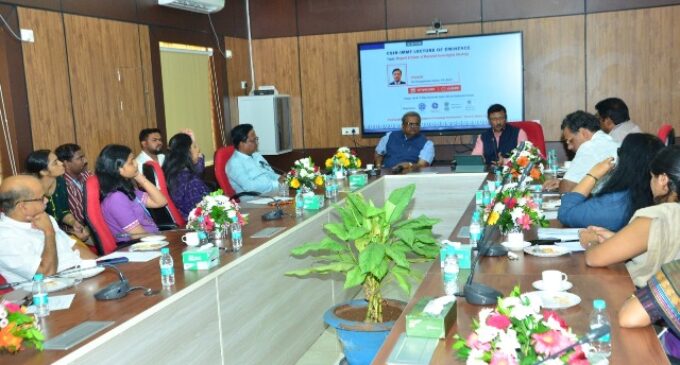
Bhubaneswar/Odisha, June 13 : CSIR–Institute of Minerals and Materials Technology (CSIR-IMMT), Bhubaneswar, organised a Lecture of Eminence by Shri Sanjay Kumar Verma, former High Commissioner of India to Canada and former Ambassador of India to Japan, the Republic of the Marshall Islands, and Sudan, on the theme “Beyond Lithium: A Material Sovereignty Strategy for India.” The programme was jointly organised by CSIR-IMMT and the Ministry of Earth Sciences (MoES) through the CSIR-IMMT Centre of Excellence under NCMM.
Addressing scientists, students, and research scholars, Shri Verma spoke on the strategic significance of material sovereignty in an increasingly technology-driven and resource-constrained world. He emphasised that material sovereignty extends beyond the availability of mineral resources and requires strong national capabilities in mineral processing, refining, recycling, and value addition to ensure long-term economic resilience, strategic autonomy, and technological competitiveness.
Speaking on the subject, Shri Verma observed, “Material sovereignty is not merely about possessing mineral resources; it is about developing the technologies, industrial capabilities, and skilled human resources required to process, refine, and transform those resources into strategic value.”
Drawing upon international experience, Shri Verma highlighted lessons from countries that have successfully strengthened material security and resource resilience. He noted that nations such as Japan, South Korea, Australia, and several European countries have adopted comprehensive strategies combining resource diplomacy, strategic stockpiling, diversified supply chains, investments in processing and refining capabilities, technological innovation, recycling, and international partnerships. He emphasised that India’s approach to material sovereignty should similarly extend beyond mining to encompass the entire value chain—from exploration and extraction to processing, manufacturing, recycling, and the development of specialised human capital.
The talk examined the changing dynamics of global supply chains, the growing importance of critical minerals in the energy transition, and the geopolitical implications of resource dependencies. It also explored the opportunities available to India in leveraging its scientific capabilities, industrial base, and international partnerships to emerge as a trusted participant in global critical mineral value chains. It was followed by an interactive session during which Shri Verma engaged with participants on issues related to processing and refining technologies, critical mineral supply chains, energy security, and emerging geopolitical developments.
During his visit, Shri Verma toured major laboratory and pilot-scale facilities at CSIR-IMMT and participated in a tree-plantation initiative on the institute campus. Dr. Ramanuj Narayan, Director, CSIR-IMMT, highlighted the institute’s initiatives in critical minerals research and infrastructure development, including facilities for rare earth element (REE) processing, recycling technologies, and platinum group metals (PGM) recovery. Dr. Kali Sanjay, Head, CSIR-IMMT Centre of Excellence and Business Development, presented ongoing activities related to research, technology development, industry engagement, and human-resource capacity building in the critical minerals sector.
The event provided a valuable platform for dialogue on the strategic role of critical minerals and advanced materials in shaping India’s future industrial and technological landscape. It also reinforced the importance of developing indigenous processing, refining, recycling, and manufacturing capabilities as essential pillars of long-term material security, technological self-reliance, and sustainable economic growth.


