

How Puri mastered the art of managing millions during Rath Yatra
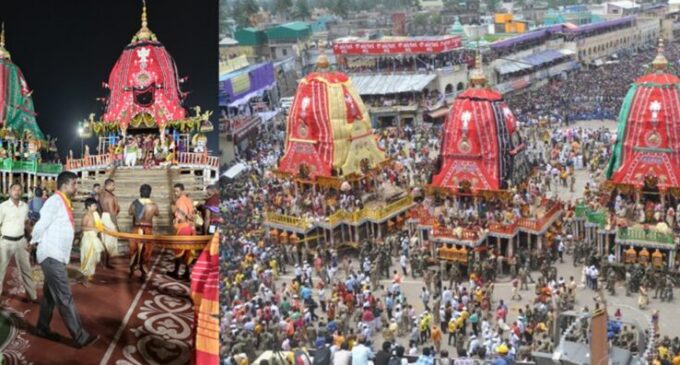
By Nalini Sahu
Bhubaneswar, Aug. 2: Every monsoon, the ancient pilgrim town of Puri performs an administrative feat that few places in the world can match. For nine days during the annual Rath Yatra of Lord Jagannath, the coastal town receives an ocean of humanity, with millions of devotees converging to witness one of Hinduism’s most celebrated festivals.
The Srigundicha Yatra alone draws more than 15 million pilgrims, while a comparable number return for the Bahuda Yatra. Several lakh devotees also assemble during Suna Besha, Niladri Bije and other important rituals. The sheer scale of the gathering makes Rath Yatra one of India’s most demanding crowd management operations, requiring months of planning and flawless execution.
This year’s festival passed off peacefully despite persistent monsoon rains, thanks to extensive preparations undertaken by the Puri district administration under Collector Dibya Jyoti Parida. Officials attribute the smooth conduct of the event to meticulous planning, inter-departmental coordination and constant monitoring before and throughout the festival.
Preparations began as early as February with the first district-level coordination meeting. Over the following months, more than 25 government departments worked in tandem on traffic regulation, law and order, sanitation, healthcare, drinking water supply, disaster preparedness and emergency response. The arrangements were reviewed periodically by Chief Minister Mohan Charan Majhi, Chief Secretary Anu Garg, the Revenue Divisional Commissioner and senior officials to ensure every component of the operation remained on schedule.
Behind the devotional fervour, officials say, lies an elaborate administrative framework that functions almost like a military operation. From the construction of the three towering wooden chariots to the return of Lord Jagannath, Lord Balabhadra and Devi Subhadra to the Srimandir during Niladri Bije, every ritual demands precise timing, seamless coordination and uninterrupted logistical support.
To strengthen field-level supervision, the state government, for the first time, deployed 23 senior officers as Officers on Special Duty besides positioning 162 Executive Magistrates at strategic locations across the town. Their work was supported by an Integrated Command and Control Centre equipped with advanced surveillance and dedicated wireless communication systems that enabled authorities to monitor crowd movement in real time and respond quickly to emerging situations.
“Managing an event of this magnitude demands complete dedication from every stakeholder. Every department, every officer, every employee and every volunteer organisation discharged their responsibilities with sincerity and commitment. Above all, it is the blessings of Lord Jagannath that enabled us to conduct the festival smoothly,” Collector Dibya Jyoti Parida said.
The administration’s biggest test came from incessant rainfall before and during several key rituals. Waterlogging in many parts of the town posed significant challenges, prompting sanitation teams to work continuously to restore normalcy. Nearly 1,600 sanitation workers, assisted by 153 garbage collection vehicles, 38 municipal pumps and additional fire service pumps, remained on duty round the clock. More than 2,500 tonnes of solid waste were cleared during the festival, while over 1,400 temporary toilets and extensive parking facilities remained operational despite the adverse weather.
Ensuring basic amenities for the massive congregation required an equally large logistical effort. Nearly 68 million litres of drinking water were supplied every day through an extensive network of kiosks, pipelines and water tankers. More than 730 authorised community kitchens and food distribution centres, supported by around 5,000 volunteers, served free meals and drinking water to pilgrims. Simultaneously, food safety officials carried out over 1,300 inspections to maintain hygiene standards.
Medical preparedness formed another critical pillar of the arrangements. The administration established 82 medical camps and 15 temporary hospitals, deploying 326 doctors, 222 nurses and hundreds of paramedics and volunteers across the town. More than 63,000 devotees received medical attention during the festival, underscoring the scale of the healthcare infrastructure created exclusively for the annual congregation.
Officials believe the successful conduct of Rath Yatra once again demonstrated that managing one of the world’s largest annual religious gatherings is as much about advance planning and institutional coordination as it is about devotion. For the administration, the festival has become an annual exercise in precision governance, where every detail—from crowd movement to public health—must work in perfect harmony.
———————
Photograph: Puri Collector Dibya Jyoti Parida reviews arrangements for the annual Rath Yatra. (Right) The towering chariots of Lord Jagannath, Lord Balabhadra and Devi Subhadra line the Badadanda (Grand Road) during the recently concluded nine-day festival in Puri.


