

Book on Sustanable Fish Feed Formulation released by SOA Founder President
By Nalini Sahu
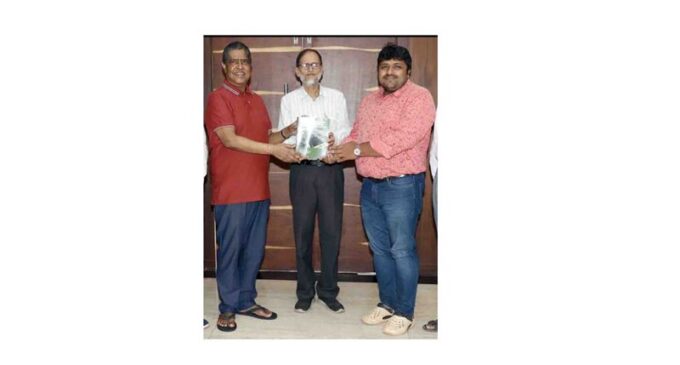
Bhubaneswar, Oct. 12: A book, titled ‘Fish Feed Formulation with Agro-industrial Wastes and Byproducts’ and containing contemporary knowledge and research findings on the innovative utilization of agro-industrial wastes and byproducts as alternative resources for fish feed formulation, was formally released by Prof. (Dr.) Manojranjan Nayak, Founder President of Siksha ‘O’ Anusandhan (SOA) here recently.
The edited volume has been brought out under the editorial leadership of Prof. Hrudayanath Thatoi, Director of SOA’s Centre for Industrial Biotechnology Research (CIBR), Dr. Pradeep K. Das Mohapatra, Professor in Microbiology, Raiganj University, West Bengal, Dr. Partha Bandyopadhyay, Chairman and Managing Director, Finay Biotech Private Ltd, Ahmedabad and Dr. Sourav Chattaraj, Assistant Professor at CIBR. It represents a collaborative scholarly effort involving esteemed researchers, scientists and professors from India and abroad, bringing together diverse expertise in aquaculture, fisheries science, biotechnology, nutrition, environmental science and related disciplines.
The release ceremony marked an important milestone for research and academic innovation at Siksha ‘O’ Anusandhan, particularly in the context of developing sustainable solutions for the rapidly expanding aquaculture sector. The book addresses one of the major challenges confronting modern aquaculture—the increasing cost and environmental burden associated with conventional fish-feed ingredients. By exploring the potential of agro-industrial wastes and byproducts as valuable feed resources, the volume highlights approaches that can simultaneously address waste management, resource recovery and sustainable fish production.
The book is particularly relevant at a time when the global aquaculture sector is seeking economically viable and environmentally responsible alternatives to conventional feed ingredients, Prof. Thatoi said.
Agro-industrial activities generate substantial quantities of residues and byproducts, many of which retain valuable nutrients. Their scientific conversion into safe and nutritionally appropriate feed ingredients can contribute to the development of a circular bioeconomy, in which waste streams are transformed into productive resources rather than being discarded, he said.
Beyond its academic significance, the publication carries considerable social and environmental importance. The approaches discussed in the book have the potential to support farmers and aquaculture entrepreneurs by reducing dependence on expensive conventional feed ingredients and encouraging the utilization of locally available resources. This could be particularly beneficial for small and marginal fish farmers for whom feed constitutes one of the major operational costs.
The book underscores sustainable utilization of agro-industrial byproducts which can also help reduce waste accumulation and associated environmental problems. Converting such materials into useful feed ingredients can create an opportunity to establish linkages between agriculture, food processing, agro-industries and aquaculture, thereby promoting resource efficiency and income generation across inter-connected sectors. The contribution of researchers and scientists from different parts of India and abroad further enhances the value of the volume by providing a broad scientific perspective on the subject.
The book is expected to serve as a valuable reference for researchers, teachers, students, policymakers, aquaculture professionals, feed manufacturers and fish farmers interested in sustainable feed technologies and stimulate further research, innovation and technology development aimed at making aquaculture more affordable, resilient and environmentally sustainable, Prof. Thatoi said.
Prof. Pradipta Kumar Nanda, Vice-Chancellor of SOA Deemed to be University, and other dignitaries were present at the book release program.


