

Lake burst in Tibet threatens fresh deluge in flood-hit Nepal after 475 deaths
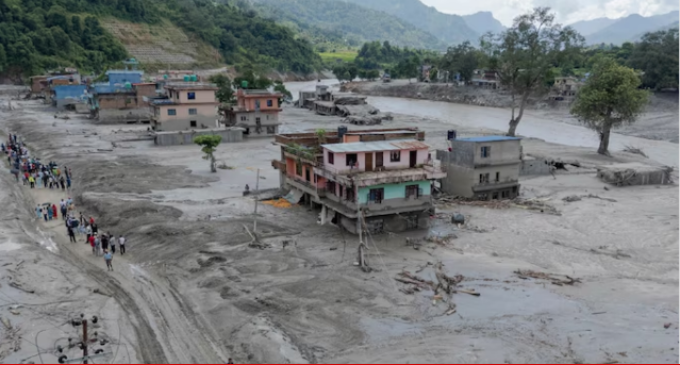
NEPAL, AUG 28 : A desperate race to find survivors after Nepal’s devastating flash floods has hit another roadblock, with a newly formed lake near the Nepal-Tibet border beginning to overflow and threatening to unleash a second deadly surge.
At least 475 people have died and nearly 1,500 remain missing on the Nepal and Tibet sides of the border after flash floods, triggered by an ice-rock avalanche following a glacial collapse near the border, tore through central Nepal on Wednesday. The torrent of water, mud and debris swept away homes, vehicles, roads and bridges and left entire settlements buried.
Police in EPNepal issued a warning on Friday that a water dam had “breached on the Tibetan side”. Chinese state media later confirmed that “overflow has occurred today” from a barrier lake, spelling the risk of further flooding near the disaster-hit border crossing connecting Tibet with Nepal. Concerns over the newly formed lake have forced authorities to suspend rescue operations in the area.
NEPAL FLASH FLOODS: LATEST UPDATES
Chinese authorities suspended rescue operations on Friday after the barrier lake formed by debris from a glacier collapse began overflowing. The lake is about 10 km from Gyirong port and contains more than 2 million cubic meters of water. Fearing a breach, Chinese rescue personnel and vehicles were withdrawn to a safer area.
Nepal’s government has also issued a fresh warning for areas along the Bhotekoshi and Trishuli rivers following increased water flow. Rescue and relief workers and people still in risk zones have been urged to move to safety immediately if conditions worsen.
The disaster began after an ice-rock avalanche linked to a glacial collapse near the Nepal-Tibet border. The resulting torrent ripped through settlements in Rasuwa and Nuwakot, carrying huge amounts of water, rocks and mud downstream. Timure and Rasuwagadhi were among the areas badly hit before the flood surged through the Bhotekoshi and Trishuli river systems.
The scale of destruction has made reaching survivors extremely difficult. Roads and bridges have been washed away, while homes, markets, farms and government buildings have been buried under thick layers of mud and debris. Several remote settlements remain cut off.
Nepalese authorities have reported 910 people missing, while officials in Tibet have reported another 558 missing. That puts the combined number of missing people on both sides of the border at 1,468.
The Ministry of External Affairs said 290 Indian nationals in Nepal remain out of reach. So far, 84 Indian nationals have been rescued. This includes 63 workers from the Trishuli-I hydropower project. Another roughly 200 Indians on the Tibetan side have sought help for evacuation.
The floods have inflicted heavy damage on Nepal’s infrastructure. The Department of Roads said the 42-km stretch between in Nuwakot and Rasuwagadhi was damaged at multiple points, with several concrete bridges washed away. Authorities said 35 motorable bridges, 45 suspension bridges and about 40 km of black-topped roads were damaged.
The Trishuli and Devighat hydropower projects and other power infrastructure were also affected. At the Trishuli-I project site, the Nepal Army rescued about 350 workers and staff trapped inside a tunnel. However, more than 100 people are still believed to be trapped there.
Meanwhile, the Balen Shah-led Nepal government said it does not need foreign assistance for search-and-rescue ops. Per reports, India, China, the US, the UK, Japan, South Korea, Sri Lanka and Bangladesh have offered to help with the operation.
The chief of the Nepal Centre for Disaster Management told Al Jazeera that about 800 people have been rescued by helicopter and 700 by land. Aid is being airlifted to survivors. However, around 644 of those missing are reportedly foreigners.
-PTI


