

Former Leader of the Opposition Debabrata Saikia terms Upper Assam floods a ‘man-made catastrophe’
By Dalim Phukan
Guwahati/Assam, Nov 5 : The devastating deluge that struck Upper Assam last July was no ordinary natural calamity, but an entirely ‘man-made catastrophe’ resulting from gross government negligence, official apathy, and rampant illegal riverbed mining.
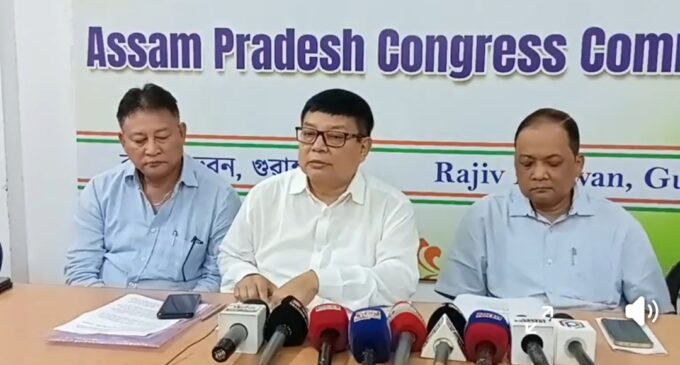
Former Leader of the Opposition in the Assam Legislative Assembly and former MLA Debabrata Saikia leveled this explosive charge during a key press conference convened at Rajiv Bhawan today.
Announcing the formal institution of a Public Interest Litigation (PIL) in the Gauhati High Court to secure justice and full rehabilitation for the flood-hit populace and uncover systemic corruption, Saikia stated that the High Court had directed the state authorities to file an affidavit by November 3. However, even after four months, the government failed to furnish vital records regarding emergency relief measures, prompting them to seek additional time, following which the court scheduled the next hearing for December 14.
Addressing the media, Saikia emphasized that all illegal and unscientific mining operations across the Dikhow River and its tributaries must be halted permanently, alongside the immediate deployment of a specialized Task Force Battalion as mandated by earlier High Court orders.
He pointed out that the unregulated extraction of natural boulders and sand has triggered the geomorphic ‘Hungry Water Effect’, resulting in severe scouring of riverbeds and widespread destruction of embankments.
Refuting official claims, Saikia highlighted that the India Meteorological Department (IMD) had issued no forecast for cloudbursts, asserting that the Chief Minister had initially peddled an unsubstantiated cloudburst narrative merely to shield favored associates. Invoking the Supreme Court’s ‘Public Trust Doctrine’ and the principle of ‘Absolute Liability’, he maintained that the state cannot evade accountability by taking refuge behind the defense of an ‘Act of God’.
Demanding an inquiry committee headed by a retired High Court judge comprising experts from IIT Guwahati and line departments to determine the root causes of the deluge, Saikia remarked that the Chief Minister’s announced CBI probe is tailored for homicides or financial fraud, whereas hydrological and environmental failures necessitate rigorous judicial oversight.
Turning to disaster relief and rehabilitation, Saikia stated that nominal SDRF and NDRF grants cannot salvage destitute households. While families suffered losses extending from several lakhs to crores of rupees, existing disaster relief norms provide zero compensation for damaged commercial establishments—such as grocery shops, welding units, automobile repair garages, handlooms, or animal husbandry ventures.
Consequently, he demanded comprehensive compensation of at least ₹10 lakh per affected family, benchmarked against the Himachal Pradesh disaster relief model.
Alleging deep-seated irregularities and favoritism, he claimed that the administration withheld public disclosure of the beneficiary roster because relief payments had been credited to multiple bank accounts belonging to families of ruling BJP leaders in non-flooded localities.
Furthermore, a significant majority of genuine victims have yet to receive the promised interim assistance of ₹15,000 and ₹10,000. For loan-burdened farmers and small traders, he cautioned that a temporary six-month moratorium offers little reprieve due to compounding interest, urging regulatory intervention via RBI guidelines and the Banking Ombudsman to ensure full debt restructuring.
Saikia also identified the proposed 11,200 MW Siang Upper Multipurpose Project (SUMP) in Arunachal Pradesh as an existential ‘water bomb’ hanging over Assam.
Dismissing the state’s claim that an 11,000 MW project could buffer against China’s 60,000 MW dam as misleading propaganda, he argued that any sudden release of upstream waters would instantly overwhelm the reservoir and submerge Assam.
Scientific studies verify that 65 to 70 percent of the Brahmaputra’s waters originate from rainfall within Arunachal Pradesh, while Tibet contributes only about 30 percent.
Alleging that the BJP dispensation is railroading this hazard to benefit allied corporate conglomerates, he reminded that NHPC had previously disregarded the findings of the Assam Legislative Assembly House Committee and downstream expert studies concerning the Lower Subansiri project.
Referencing Lok Sabha MP Gaurav Gogoi’s four-page formal representation to the Union Jal Shakti Minister, Saikia extended complete solidarity to the democratic agitation led by the indigenous Adi community in Arunachal Pradesh, demanding public hearings across downstream Assam and an immediate moratorium on all project activities.
He also called for binding judicial directives requiring corporate major ONGC to finance home reconstruction and educational and livelihood rehabilitation in flood-ravaged zones instead of confining itself to optical CSR contributions.
In response to press queries, Saikia criticized the Water Resources Minister and the state administration, noting that as a sitting legislator he had continuously submitted formal requisitions for embankment construction since 2021.
In the absence of an embankment, surging floodwaters submerged residences up to the rooftop within half an hour without breaching any protective bund.
Highlighting questionable fiscal priorities, he questioned why ‘B’ Block at Janata Bhawan, Dispur, was demolished and rebuilt at an expense exceeding ₹100 crore while adjacent blocks remained fully serviceable.
He also criticized the unbridled construction of flyovers across Guwahati contrary to advice from ‘Metro Man’ E. Sreedharan—who noted that flyovers offer no permanent remedy for urban gridlock—alleging that projects were executed for commission revenues, including one near the MLA Hostel that was retroactively tendered five months after completion.
Saikia further criticized recurring police encounters as staged and extra-legal. Referring to the recent murder at Hotel Bilas Inn near Bora Service in Guwahati, he voiced suspicion that the incident was linked to the commercial interests of influential individuals and could represent a contracted execution (‘supari killing’).
He expressed concern that the accused was eliminated in an encounter on directives from higher authorities to prevent revelatory testimony from surfacing in court. Concluding his address, Saikia accused the ruling dispensation of utilizing the rhetoric of ‘Jati-Mati-Bheti’ to enforce selective evictions targeting indigenous communities—including the Rabha, Tiwa, and Bodo peoples—while facilitating the transfer of Assam’s land and resources to external commercial conglomerates.
Media Chairman Bedabrat Bora, APCC General Secretaries Bipul Gogoi and Ramanna Baruah were also present at the press conference.